School Days Scotland
It is February, and the Fife has been locked in that endless damp-gray since Christmas. The sky is a low, impenetrable wool. The bus sits at the edge of the car park, heater on the fritz, windows fogged from the churning carbon dioxide of forty-four adolescents in various stages of irritation, hormonal fug, and crisps.
At the very back—near the engine’s grumbling heart—James has barricaded himself with his satchel and his army-surplus greatcoat, knees drawn up on the vinyl seat. Outside, frost clings in the shadows but the roads are rivers of dark slush, always threatening to throw the bus into a ditch. It’s a two-hour drive to Edinburgh, and the only thing on James’s mind—apart from the distant terror that they’ll be forced to do country dancing at the Youth Hostel—is the memory of Kate, preserved with molecular fidelity since that school disco at Christmas.
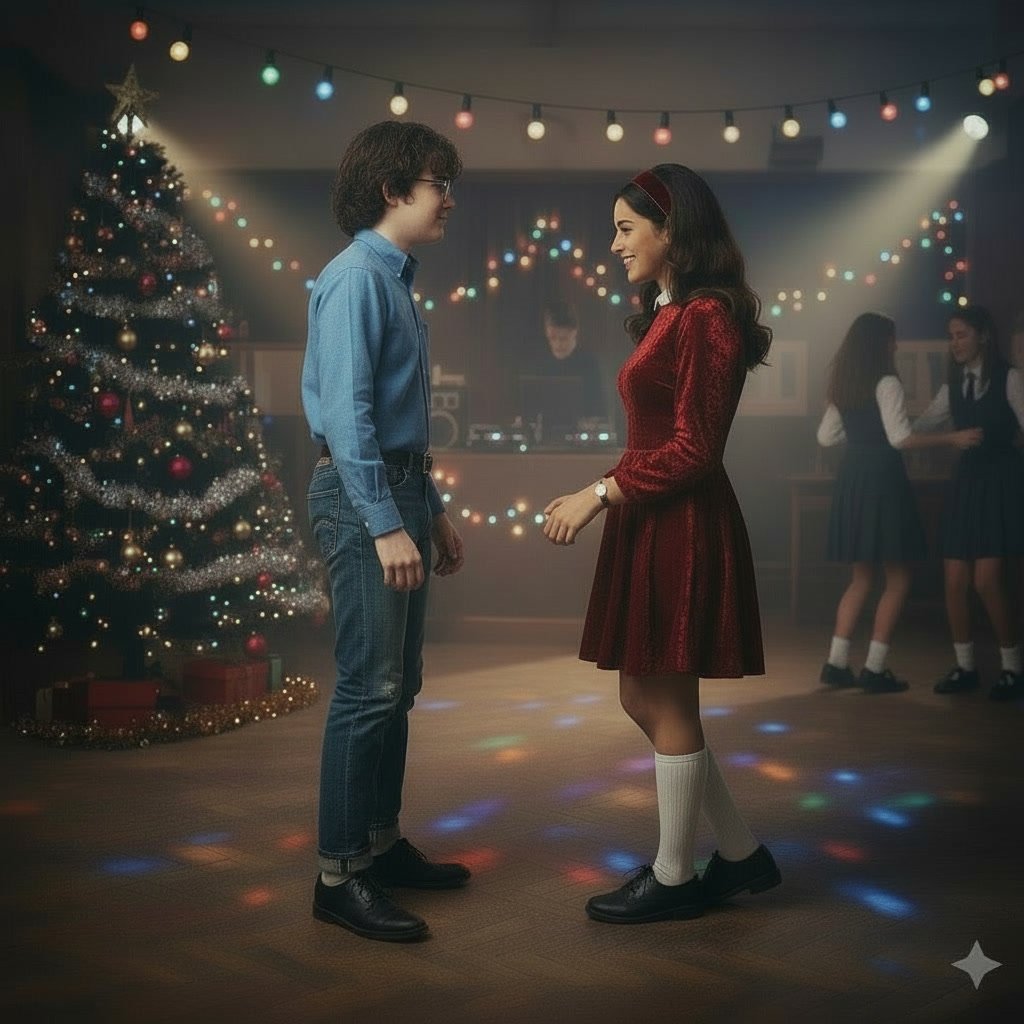
He tries to read, but the ink blurs with each new jolt. Even when he closes the book and lets his head fall back against the window, the condensation is cold and his breath clouds the glass. He draws circles absently with his finger, thinking of the last time he saw her: the deep red of her dress, the cloud of her hair in the humid gymnasium, the way she pressed her thumb to his wrist on the frost-slicked playground wall. The look in her eyes.
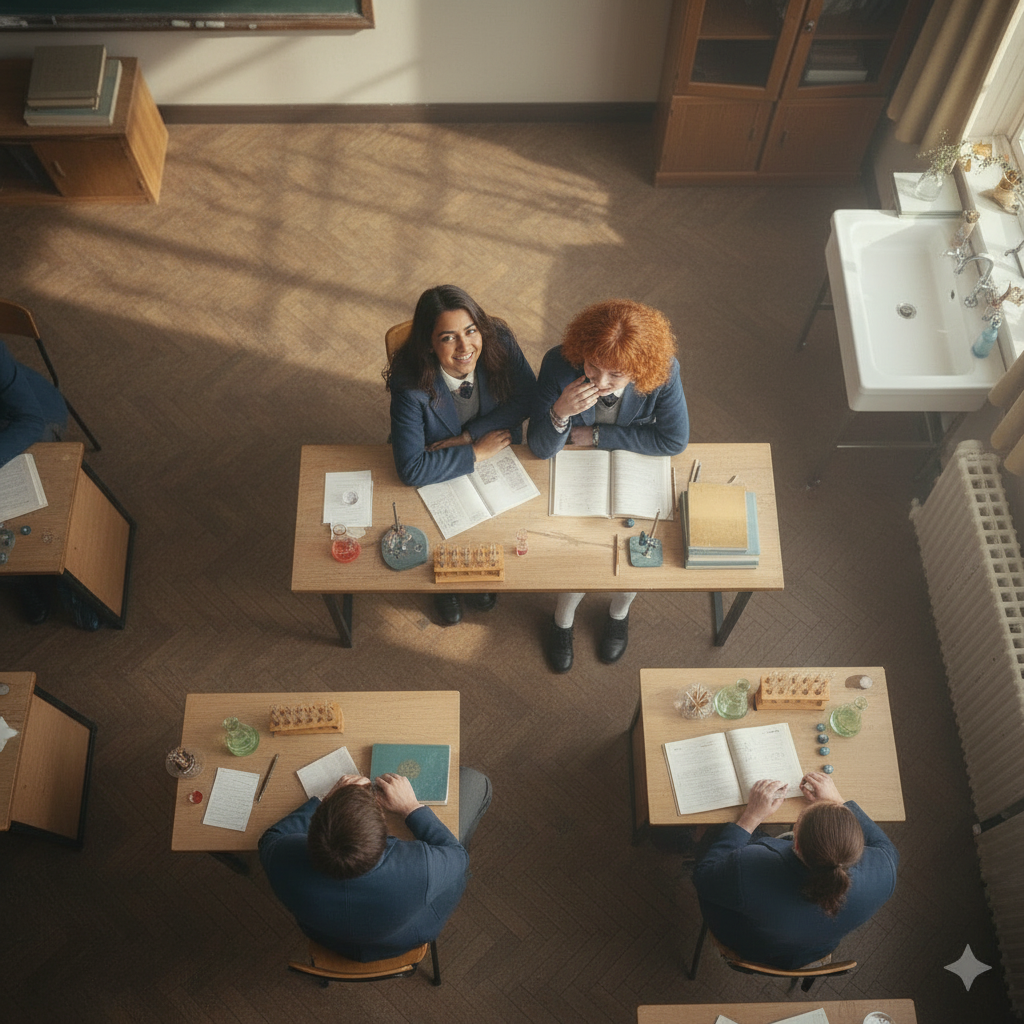
Every three seconds, his thoughts make a full orbit of shame, longing, and self-disgust—like an electron refusing all attempts at classical description. He has replayed the aftermath of that night so often that he can now remember the way she bit her lip when she looked at him across the science bench. He can even recall, with queasy detail, how he panicked and returned to his old habitat at the library, barely managing a nod in her direction for the rest of term.
James is so deep in the feedback loop that he doesn’t notice the girl in the seat across the aisle. She is reading a battered paperback, its spine broken and held together with yellowed sellotape. Her hair is mousy and cropped short, and there’s a scattering of freckles on her nose. She looks up only when the bus judders violently over a pothole.
She sees his finger drawing on the glass and snickers, the sound slicing through the humid air. “What are you, five?”
James, mortified, wipes the window clean. “It helps me think,” he says, too quickly.
She looks at him, head cocked. She slides into the seat next to him. “I’m Bryony,” she says. “You’re the clever one, right? They said if I get lost at the museum, I should find you because you know all the words for ‘help, I’m trapped.’”
She grins, then drops her eyes back to the book.
He is rescued by the PE teacher, who stalks the aisle, barking at the boys to keep their feet off the upholstery and the girls to “put away that eyeliner, you’ll all look like pandas by the time we get there.” James retreats behind his book, grateful for the brief interruption of shame.
But Bryony’s question remains: who is he, really, outside the ongoing saga of Kate? The back of the bus is supposed to be the territory of the wild and the lawless, but here it is mostly ghosts and gnawed pencil stubs. As the bus trundles north, the school’s outskirts melt into soggy farmland, then into a blur of market towns and roadside crows. The world outside is monochrome, save for the occasional burst of daffodils along the verge.
*
At the observatory, the wind is so sharp it flays the skin from James’s knuckles as he shoves his hands into his coat pockets. The building itself is an Edwardian lump—red brick and weathered stone, squatting on the crown of Calder Hill. The boys and girls are herded inside, jackets steaming, and released into a museum that smells faintly of disinfectant and aniseed balls.
The domed main chamber is filled with glass cases: armillary spheres, battered orreries, a lunar globe so scarred that James feels a pang of kinship. A guide in a brown suit gives a lecture on the history of astronomy, projecting transparencies onto a silver screen. James already knows the names—Herschel, Copernicus, Hubble—and quietly corrects the guide’s pronunciation of “Tycho Brahe” under his breath.
He pretends to be interested in the display about the 1957 launch of Sputnik, but what he’s really looking at is the brass telescope mounted at the window, aimed skyward as if the clouds might someday part and admit the possibility of escape.
During lunch, they’re given packets of Ready Salted and left to explore the side galleries. Most of the boys cluster by the meteorites, inventing creative ways to weaponize them. James migrates to the far room, which houses the “Famous Scottish Inventors” exhibit—James Clerk Maxwell, John Logie Baird, Mary Somerville—hoping no one will notice his absence.
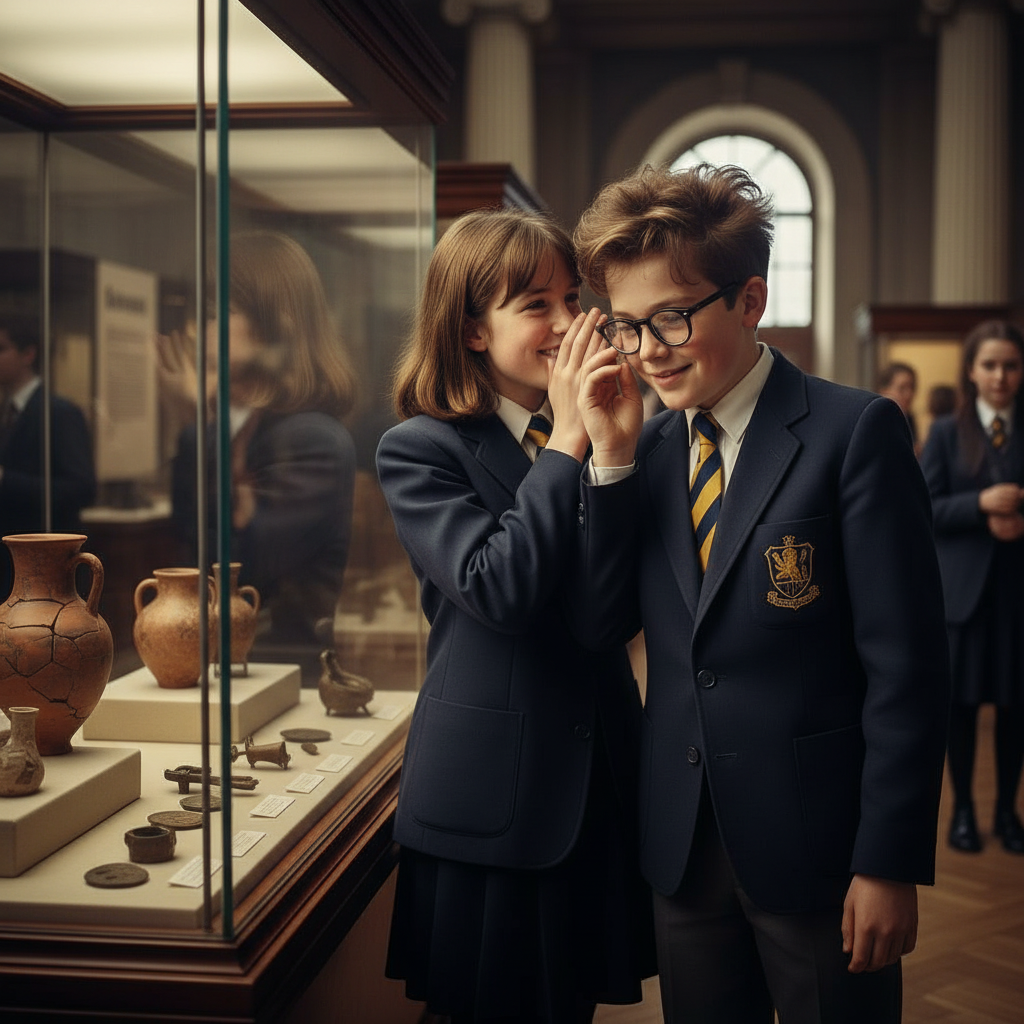
But Bryony finds him anyway. She stands beside the glass case containing Maxwell’s letter to Faraday, hands deep in the pockets of her pea coat.
“Why do you do that?” she asks, peering in at the faded ink.
James blinks, caught off guard. “Do what?”
She makes a face, pushing her fringe out of her eyes. “Pretend you’re not here. Like you’re a hologram. Or like you’re waiting to be beamed up by aliens.”
He laughs, a sound so strange that it surprises both of them.
“It’s just easier,” he says, “if you’re invisible. Less chance of making a mess of things.”
She shrugs. “Yeah, but more chance you’ll get stuck. Or disappear entirely. Which would be a shame, because apparently you know all the constellations and can recite the entire periodic table backwards.”
She is grinning again, an impish, sidelong smile, as if she is in on a joke that he has only just begun to understand.
They drift together for the rest of the afternoon: Bryony asking questions in rapid fire, James answering at first with single-word responses, then gradually expanding into paragraphs as he realizes she isn’t mocking him—she’s genuinely curious. They get in trouble for sneaking into the off-limits “staff only” gallery, where James gives a lecture on spectroscopes so animated that a teacher interrupts them, convinced they’re plotting mischief.
On the return bus, it’s Bryony who sits next to him. She doesn’t ask permission; she just collapses onto the seat and hunches down with her knees drawn up, mirroring his posture.
It is, for James, like stepping into a parallel universe: one in which he is still himself but the air isn’t so thick with the smell of failure and regret. The two of them make up new constellations as dusk falls—a stick-figure man with an umbrella, a rabbit leaping over a hill, a dragon eating the moon. Bryony giggles so hard at the “Egg and Spoon Nebula” that she almost chokes on her Polo mint.
For two glorious hours, the memories of Kate recede, softened to a pale ache by the present-tense hilarity of the moment. James even manages to tell a joke (about Tycho Brahe’s metal nose) that gets an honest-to-God laugh out of Bryony and the other kids within earshot.
He leans back, feeling—if not light, exactly—then at least less like a stone at the bottom of a cold river.
*
In the weeks that follow, James carries the bus ride with him like a lucky talisman. It’s not that he and Bryony become an item—he doesn’t even know the steps for that particular dance—but there is a comfort in their exchanges. In the lunch queue, she always bumps him forward when he stalls; in double English, she slips him cryptic notes (“Explain the runcible spoon”). When she skips ahead of him in line, she does so with a mock-curtsey, and he learns to respond with a flourish of his own.
The spell of Kate is broken not by passion, but by this slow, persistent friction of friendship, gently eroding the glacier of his previous obsession.
James learns to be less invisible. He puts up his hand in class more often, even if he gets the answer wrong. He starts to believe, against all accumulated evidence, that the world might not be waiting for him to slip up.
And then, in the desolate hangover of June, his father returns home with news: a job offer in the north, up near Invergordon, “a real promotion, son, but it means packing up the lot and heading to a new place.”
James feels the blow before the sentence lands, a sense of loss so total it presses the air out of his lungs. He lies awake that night, listing all the things he will lose: the library, the nearby pebble beach, the slow accretion of trust with Bryony. Most of all, he mourns the possibility that, here, he might have finally learned how to be a person among people.
On the last day of term, James is called to the office for an early dismissal. The corridor is empty; the lockers already stripped of stickers and graffitied insults. He passes the science lab, the door ajar, and glances in at the empty benches. For a moment, he sees the ghost of himself and Kate, hovering just out of reach.
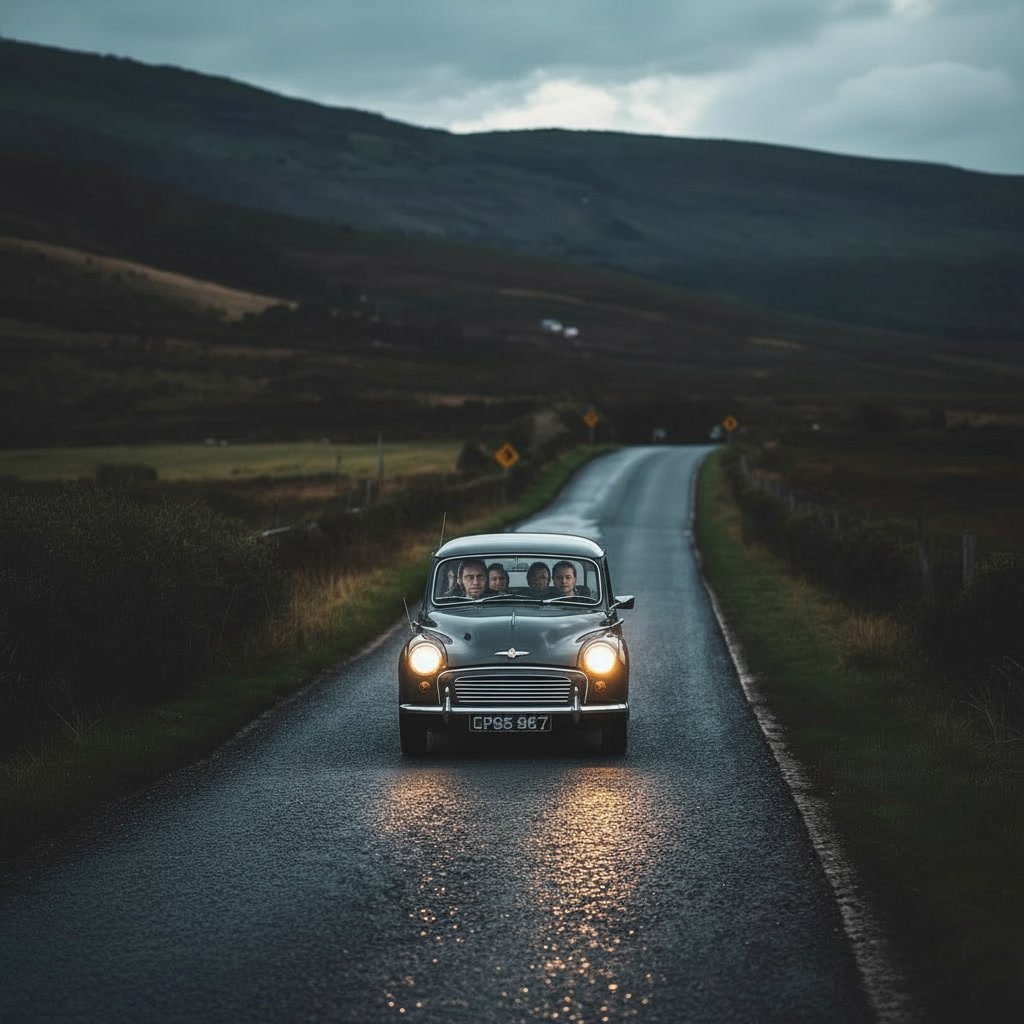
When he leaves the building, the sky is the impossible blue of rare Scottish summer. In the car, his parents make nervous small talk, their voices thin with unspoken guilt. As the city recedes, James thinks about the stars above the observatory, how they never change position no matter where you stand on the planet.
He wonders if, up in the far north, the constellations will look different. He wonders if, given enough time and distance, even a memory as sharp as Kate’s thumbprint on his wrist might finally fade.
Beside him, the car window is cold and the road a bright ribbon through the fields. He traces a circle on the glass, and somewhere—in a universe adjacent and slightly more forgiving—a boy with wild hair and a blue shirt is dancing, and this time he doesn’t run away.